When we last posted, the boys were complaining about the boring weather of some sun and no wind. The second half of week 1 cured them of that complaint as we spent the rest of that time stuck in an anchorage. We started off with 4 lines to shore plus the anchor. After the first night we had 8 lines plus the anchor and after the second night we had 9 lines plus the anchor. A fairly significant low sat over our position for 6 days. We saw some pretty good gusts in the anchorage but with 9 lines to shore felt nice and safe.
We spent the time doing many boat projects. Sewing, electrical, mechanical ,woodworking and cooking took up our days. It felt like home-ec, shop and mechanics classes all rolled into one session. Nights were spent watching TV, sleeping and reading. Time passed slowly. Too slowly... The natives on the boat started getting restless and were demanding more and more jobs to keep them busy. I was handing out jobs that had been on the to-do list for almost a decade just to keep them happy.
To make matters worse there were periods of long calms in between the gusts and it was hard to justify sitting when the winds didn't seem that bad... When the jobs ran out I was forced to look very closely at the weather and try to find some window of opportunity to move on. After scouring the guide books and weather charts we came up with a plan to end the boredom.
The weather window was iffy, the next anchorage unknown but it was decided we could always return if needed so on the 7th day we untied the boat in the early morning and started out with a breezy 20 knots against us. It was a bit of a slow go but not too unconformable and after a few hours we were even able to get some help by using the staysail. After a pretty long day we made it to the planned anchorage and set about trying to sort out how to get the boat secured.
By this time it was snowing with winds around 30 but at least we were protected by the small nook so the seas were calm. A few exciting moments ensued and through strength and determination we were able to secure our selves to the fisherman's line at the peak of the squall passing through. We caught our breath and then went on with the task of running our own lines to shore just ask dusk was starting to set in.
After a hot dinner we all fell into bed, knowing that the next day would be just as challenging. This was ok as by now the go to phrase around the boat was "At least it's not boring..."
----------
Sent via SailMail, http://www.sailmail.com
Friday, October 14, 2022

Saturday, October 8, 2022
A good first week Part 1
Sea Rover got off to a roaring start and made great time over the first part of week 1. The most spectacular part of the whole trip can be summed up in just a few anchorages and we've managed to check two of them off the list.
Caleta Olla was the first stop arriving there a day earlier than we had even planned to leave. This involved unceremoniously throwing Karina off the boat for a night in the cold. The weather window was just too good to pass up.
Olla is a nice bay surrounded by a large granite mountain with a glacier just poking out from behind. We tackled fixing the outboard in the morning and then while I did some last minute jobs, the boys made a quick trek up to check out the glacier. As usual, words cant do the scenery justice but we have pictures ready to upload when we get back. In the late afternoon the weather was still holding so we took off for goal number 2. Seno Pia.
After a calm motor down glacier alley (much different than last year) we somehow timed arriving at the entrance to Seno Pia and the sunken moraine at exactly low tide. We managed not to run aground and continued up the narrow channel with 3 large tide water glaciers flowing into the ocean around us. The hook was dropped just as dusk was falling.
The next day we explored the closest glacier by dingy, working our way slowly through the minefield of bergy bits. We stopped on shore at the foot of the glacier and Mark got some great footage with his drone. After watching a few blocks roll down the jagged landscape of snow and ice we headed back to the boat to prepare for an easy walk up the hill behind us.
That easy walk ended up being a surprisingly difficult route finding mission. Apparently when Covid prevents cruisers from exploring this fantastic anchorage for two years the land returns to its untouched beauty and all trails are erased from existence.
It was now day 3 of calm winds and reasonable weather and the boys were wondering if I had been telling fibs about the potential for difficult weather.
I knew our luck would quickly run out so it was certainly a great introduction to Patagonia and it gave us time to all get to know the boat and each other in a nice calm classroom setting. Becoming a team of well seasoned sailors was important for what lay ahead. Sadly it only took a few more days before we were forced to level up our skills but that will be a story for another day.
Caleta Olla was the first stop arriving there a day earlier than we had even planned to leave. This involved unceremoniously throwing Karina off the boat for a night in the cold. The weather window was just too good to pass up.
Olla is a nice bay surrounded by a large granite mountain with a glacier just poking out from behind. We tackled fixing the outboard in the morning and then while I did some last minute jobs, the boys made a quick trek up to check out the glacier. As usual, words cant do the scenery justice but we have pictures ready to upload when we get back. In the late afternoon the weather was still holding so we took off for goal number 2. Seno Pia.
After a calm motor down glacier alley (much different than last year) we somehow timed arriving at the entrance to Seno Pia and the sunken moraine at exactly low tide. We managed not to run aground and continued up the narrow channel with 3 large tide water glaciers flowing into the ocean around us. The hook was dropped just as dusk was falling.
The next day we explored the closest glacier by dingy, working our way slowly through the minefield of bergy bits. We stopped on shore at the foot of the glacier and Mark got some great footage with his drone. After watching a few blocks roll down the jagged landscape of snow and ice we headed back to the boat to prepare for an easy walk up the hill behind us.
That easy walk ended up being a surprisingly difficult route finding mission. Apparently when Covid prevents cruisers from exploring this fantastic anchorage for two years the land returns to its untouched beauty and all trails are erased from existence.
It was now day 3 of calm winds and reasonable weather and the boys were wondering if I had been telling fibs about the potential for difficult weather.
I knew our luck would quickly run out so it was certainly a great introduction to Patagonia and it gave us time to all get to know the boat and each other in a nice calm classroom setting. Becoming a team of well seasoned sailors was important for what lay ahead. Sadly it only took a few more days before we were forced to level up our skills but that will be a story for another day.
Sunday, October 2, 2022
Leaving Puerto Williams
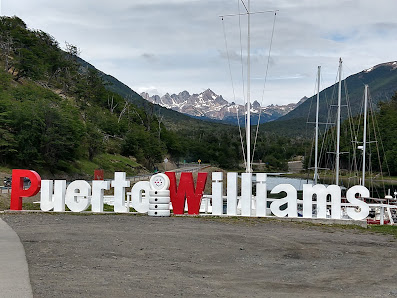
After 2.5 years Sea Rover left Puerto Williams at 7am this morning to start her trek north towards warmer climates. We have loved our time in Tierra del Fuego but Sea Rover needs some loving that only a stint on the hard in Puerto Montt can provide. Why go now at the end of the cold Austral winter, you might ask? Perhaps counterintuitively, there are more days of calm, sunny weather in the winter in the deep south compared to the summer. Having experienced a number of Austral summers, I hardly think it could be worse! And since Sea Rover needs to travel 1300 nm north against the prevailing north winds, a few days of relative calm here and there where the boat wouldn't be pounding into a 30 knot headwind sounded like a good plan.
As with all good plans, there was a snag. Karina was in the middle of a huge project at work and couldn't take time off. So on to Plan B. Gary found Crew willing to spend a long period of time in a small boat motoring through some of the most challenging but most beautiful waters in the world. Joining Gary for this trip are Karina's cousin Mark, as well as Brian and Allan from Piers Island.
 |
| I hope the Crew are hungry!! |
Gary and Karina spent the month of September doing small boat projects, provisioning with water, diesel (790 L by HAND!!) and food (hundreds and hundreds of pounds). Sea Rover has never been so low in the water.
 |
| Ushuaia |
We took a small detour to Ushuaia to reset the boat visa (with thankfully less drama than last time) and remembered why we both love and hate the town. Ushuaia is a lovely, vibrant city with nice restaurants and beautiful scenery, but it must be the windiest city in the world. It is always a challenging place to be in a boat.
While in Ushuaia we met up with our old friend Rene, who is now Ata Ata-less as he recently sold his boat to one of the other Cruisers in Puerto Williams. He is now living on land in a warm, dry house with his lovely girlfriend Graciella in town. It was wonderful to see him again as we don't know where our next meeting will be...
 |
| Club room at the Micalvi with flags from Cruisers around the World |
 |
| Quietly motoring out of Puerto Williams on a calm morning |
 |
| Bluewater Cruising burgee put to good use. |
 |
| The remains of the flag we had up during the pandemic. A fitting end for it, I think. |
Saturday, February 12, 2022
Making Sea Rover Legal and Putting Her to Bed
We are currently sitting by the pool at an airport hotel in Santiago waiting for our flight back to Canada after a short season in Tierra del Fuego. The boat was in better condition than we could have hoped after sitting for 2 years without being properly winterized. The engine drips salt water out of the heat exchanger, but this seems to be a manageable issue. A few of the electonic tools packed it in, but all the truly important stuff like radar, AIS, chart plotter, GPS worked as expected. We managed to rescue the lithium batteries, but the start batteries didn't survive. The zincs on the props were even still reasonably intact. And most importantly, everthing inside the boat was dry and there was very little mold. Because she fared so well, we didn't feel the urgency to "get her out of Patagonia" that we were feeling before we left Canada. Plus, our boat visa was expiring in February 2022 and we knew it would be difficult to renew it if we went to Puerto Montt. So we opted to stay in the far south for another season with the hopes that the port of Puerto Williams would miraculously open.
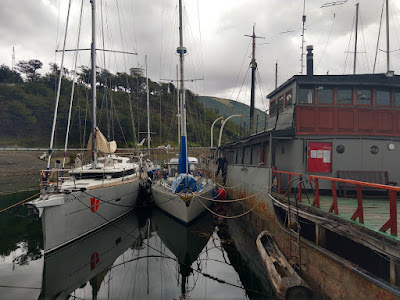
We sailed back to Puerto Williams and were directed by the Navy to anchor just off the Micalvi to wait out our quarantine over the weekend. On Monday morning we met Natalia at the dock where she administered another antigen test under the watchful eye of the Navy. After receiving the all clear, we checked back into the country and obtained our new boat visa. We are good for another 2 years. Getting the visa sorted out was a hassle, but we are very glad we did it. The irony of the whole thing was that they opened the port in Puerto Williams 2 weeks later, not that it would have necessarily made the whole process any easier. From what we could tell it just made the quarantine period go away.
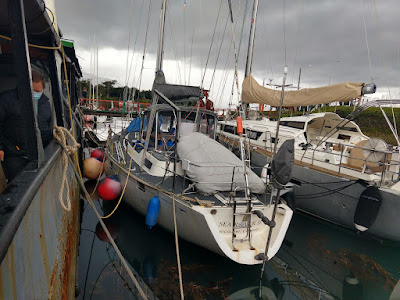
We spent the last few weeks doing some boat projects (installing an antenna mast, running antenna wires, installing new solar panels) and putting the boat to bed for the season. We managed to score a spot on the inside of the Micalvi this year. As the inner bay is narrow and shallow only 2 boats can raft. We are still tied up directly to the Micalvi, but we only have 1 boat attached to us versus 7. Plus the prevailing wind will push us off the Micalvi instead of onto it.
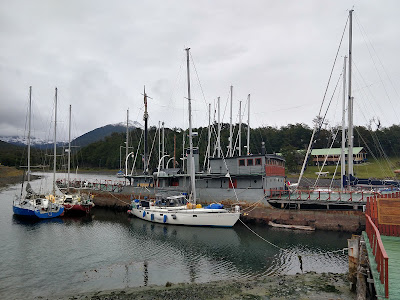 |
| Sea Rover on the inside of the Micalvi |
After enjoying a few weeks in the Beagle Channel, we returned to Puerto Williams and learned that one of the French boats, with a similar boat visa issue to ours, had been granted permission to sail over to Ushuaia and return even though the port was still closed. This would effectively renew their visa for another 2 years. They arrived back in port the same day we did and so we interrogated them as to what they had to do. Basically, the Port Captain was willing to let foreign boats from Puerto Williams leave and return as long as they got permission from the Health authorities. Thankfully the French couple had done all the legwork to figure out how to arrange all the necessary testing and paperwork with Health, so we followed their instructions. A big thank you to Natalia, in Puerto Williams who arranged everything for us on the Puerto Williams side, and Roxana who made it all happen in Ushuaia.
The process started with an antigen test in Puerto Williams that would allow us to enter Argentina. We then visited Immigration, Customs and the Port Captain to clear out of the country. We sent our results, vaccine passport and proof of insurance information to Roxana in Ushuaia ahead of time so that she could clear us in with their local health authorities. She met us at the marina in Ushuaia when we arrived, gave us copies of all the clear in forms, and then made an appointment with the Immigration office. Steps 1 and 2 complete. After clearing in with Immigration, we went to the Customs office and got our temporary import visa. So far so good. Then we went to the Prefectura (the equivalent of the Port Captain in Argentina) and everything went horribly wrong. We handed them stack of completed paperwork and told them we had just arrived from Puerto Williams. Several of the officials conferred for a few minutes, said a bunch of things to us in unintelligible (at least to us) Spansish, then gave us 5 more forms to fill out. The forms were things like an affidavit saying we wouldn't go to the Malvinas (Falklands) which didn't make any sense for people clearing in. When we tried to question it, they just kept pointing to the forms and saying 'fill them in'. So we did. Then they looked at the forms we'd received from Immigration and Customs and realized one of the forms was missing a stamp. So we tromped back to the Customs office to get a stamp. After handing the newly stamped forms to the Prefectura, they then announced that we'd filled in our entry paper wrong. I had put our port of origin as Puerto Williams and port of destination as Ushuaia. Seemed pretty clear to me (the form was in Spanish and English so there was no possible way I could get it wrong). They guy kept arguing that we weren't clearing in, we were leaving. No, we said, we are arriving from Puerto Williams today and returning to Puerto Williams tomorrow. No, he said, you are leaving for Puerto Williams. And on it went. He finally took our papers, crossed out what I'd written in the origin/destination box and re-wrote the information. He was so adamant that we finally thought that maybe they had decided to do our clear in and check out at the same time (as we had originally told them we were returning to Puerto Williams the next day). Although we were skeptical, we couldn't seem to make him listen to us, so we took the papers and left.
Next on the list was getting a PCR test so that we could return to Chile. We walked to the other end of town and went to the address the French boat had provided. Thankfully the woman at the desk spoke English so it was easy to book an immediate appointment. She gave us the address of the clinic and some directions, and off we went. After a bit of wandering in the direction she'd sent us, we realized the address was for the loading dock behind the hospital! We were met by 2 friendly people dressed in multiple protective gowns, face masks and face shields, and we completed our test sitting on chairs in the loading bay. A bit surreal, but at least it was outside.
We then returned exhausted to the boat, only to be told by another sailor that the Prefectura had been trying to reach us on the radio. No kidding.... I had to work, so Gary tromped back over to the Prefectura's office. They told him he'd made a mistake on the form and that he was clearing in, not out.... They gave Gary new forms and told him he had to get new stamps from Immigration and Customs. By the time all of this was completed both offices were closed. Grrrr.
The next morning we met up with our friend Rene from Ata Ata, who is fluent in 9 different languages. He was clearing in as well, so he offered to translate for us as we went through the process of clearing in - again. Our first stop was the Customs office. We told the Customs official that we needed new papers as the Prefectura had a problem with the first set. He refused saying he had already filed the paperwork to clear us in and he couldn't do it twice. Rene managed to get him to give us copies of the papers he'd signed and stamped the day before. We then tromped back to the Prefectura's office and gave them the copy. At first the guy we'd been dealing with said that the copies weren't good enough. I told him that was all we were going to get so he could decide what to do with it. He went away for a while, then came back and said we were now cleared in!!
We then told him we wanted to clear out. He gave us the forms and off we went, back to Immigration and Customs to clear OUT of the country. I'm sure the Customs guy thought we were insane... Anyway, by 11:30 we had officially cleared out of the country again. The Prefectura then informed us that we'd have to leave the country by 1pm as that was the time we'd told them we'd leave the day before when we were in the midst of the clear in/out debacle. Usually you have 24 hours to leave the country once a zarpe has been issues. While what they were asking was completely unreasonable, we didn't argue. We were gone by 12:15. What an ordeal.
We sailed back to Puerto Williams and were directed by the Navy to anchor just off the Micalvi to wait out our quarantine over the weekend. On Monday morning we met Natalia at the dock where she administered another antigen test under the watchful eye of the Navy. After receiving the all clear, we checked back into the country and obtained our new boat visa. We are good for another 2 years. Getting the visa sorted out was a hassle, but we are very glad we did it. The irony of the whole thing was that they opened the port in Puerto Williams 2 weeks later, not that it would have necessarily made the whole process any easier. From what we could tell it just made the quarantine period go away.
We spent the last few weeks doing some boat projects (installing an antenna mast, running antenna wires, installing new solar panels) and putting the boat to bed for the season. We managed to score a spot on the inside of the Micalvi this year. As the inner bay is narrow and shallow only 2 boats can raft. We are still tied up directly to the Micalvi, but we only have 1 boat attached to us versus 7. Plus the prevailing wind will push us off the Micalvi instead of onto it.
That's if for us for the next few months while we return home to make our house habitable again...
Thursday, January 13, 2022
A Reminder of Why Most People Don't Sail Here - Part Two
January 1, 2022
We are hoping that how our year started is not an indication
of how the rest of the year will go…
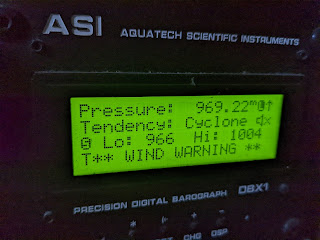
For our short trip this year we had hoped to loop around Isla Gordon and visit the glaciers in the North and South arms that lead into the Beagle Channel. By January 1st it was clear that the weather was not going to cooperate with this plan as a series of strong lows were forecast to come through for the remainder of the week. The first system was predicted to be a 961 millibar low. For those of you who are non-sailors, that is VERY big low and usually means you can expect very strong winds. Our barometer was kind enough to tell us that a Cyclone was coming… The storm was expected to hit Tierra del Fuego on January 2nd. The winds on January 1st were supposed to be light from the NE. As Caleta Olla is not all that protected from the E, we decided we’d move 25 miles west to a small hurricane-hole anchorage called Caleta Cinco Estrellas.
We woke up on January 1st to the bump of us running aground in Caleta Olla when the wind switched to the NE. Oops. Luckily it was a soft bump and pulling in 10 feet of anchor chain solved the issue. But, feeling that this was a harbinger of things to come, we decided we’d pull anchor and head to Cinco Estrellas. As I pulled the lines from shore, Gary pulled in some more of the anchor chain. While we were sorting out the lines on deck, a big NE gust came and blew the boat sideways. The anchor dragged and we found ourselves beam-to on the shore. Crap. Luckily the mud was soft and we were able to back off without difficulty. But still. It wasn't yet 7am in the new year and we’d already run aground. Twice.
We finally got sorted and motored out of the cove. The channel just outside the cove was a sea of white. Hmmm, this was kind of unexpected based on the wind forecast (NE 10 knots). But on we went. Once out in the channel, the wind started off from the NE, but we were immediately bucking into 3-4 foot seas on the nose. Wind against current? We continued on. Another 0.5 nm further along and suddenly the wind was 20 knots from the W, so directly on the nose. OK, at least this explained the seas. Regardless of the wind and waves, we were actually making decent speed (4-5 knots) so we decided to continue on.
Then the conversation in the cockpit went something
like this:
Gary: Do you see that weird water thing over by the shore?
What do you think it is?
Karina: It looks like a water spout.
Pause.
Karina: No, I think it’s a waterfall spraying up in the wind.
Long pause.
Karina: No, it’s
definitely a water spout.
And so it was. For the next 2 hours we were hit by no less than 20 violent ‘rachas’ (ie, VERY strong 50+ knot wind gusts) in the form of visible water spouts. If we’d stopped to really think about it beforehand we would have realized that NE winds would funnel down the glaciers on the north side of the channel and hit the water as violent wind gusts, aka rachas. Rachas are a common phenomenon in Chile given the topography and typical wind strengths. We have spent our entire time in Chile so far avoiding anchorages reported in the guidebook to experience rachas. And up until January 1st, we’d been mostly successful. After January 1st though, I think we have experienced more rachas than most people in the world.
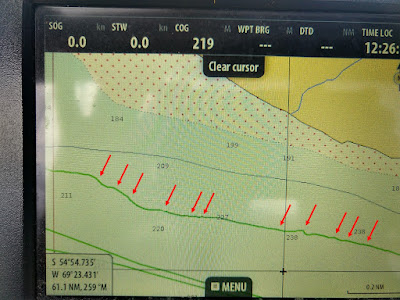 |
| GPS track through the Racha area - each arrow was a 'hit' |
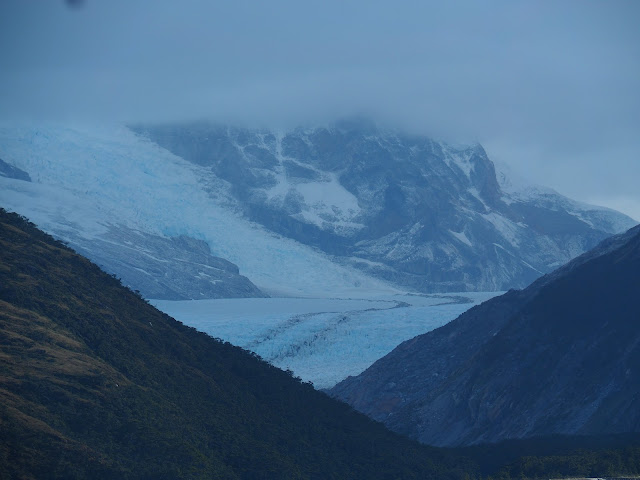 |
| Allemande glacier - it looks nasty, doesn't it? |
And then, just like that, we were through it and the seas
were calm with a gentle breeze against us. It felt like we’d just run a gauntlet
of dragons… but, we survived. While the
crew were shaken, Sea Rover was no worse for wear.
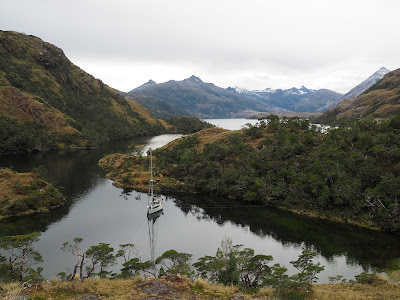 |
| Caleta Cinco Estrellas |
We made it into Caleta Cinco Estrella, our chosen hurricane hole and prepared for the storm expected the next day. We anchored and tied 5 lines to shore (after the morning we’d had, we weren’t taking any chances). I went for a small hike and explored, then we hunkered down for the ‘storm’. As advertised, the cove really was bomb-proof. We had the occasional gust during the storm, but nothing menacing. It snowed, hailed and freezing rained most of the storm day so we hibernated on board.
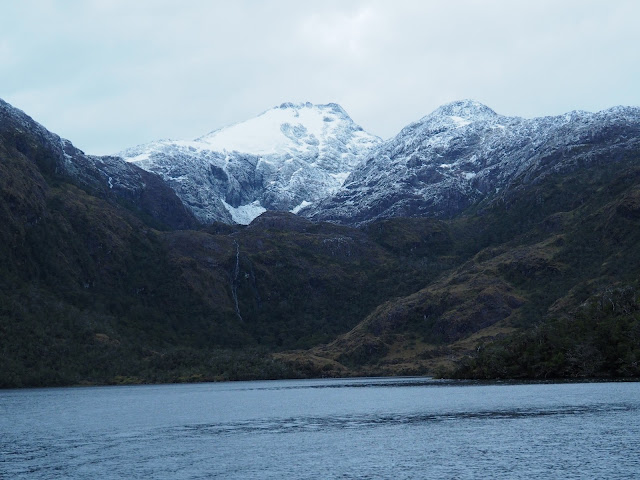 |
| Entry to Caleta Cinco Estrellas after the storm deposited fresh snow |
The next day we decided it was time to head back towards Puerto Williams. The wind was from the traditional direction (ie, W) so we were pretty sure that the dragons would keep to themselves through the now-dreaded glacier stretch, but we were wary of any thing moving on the water, ie, sun beams, mist etc. Thankfully our passage was smooth. We had a very fast sail in 30 knot winds (from behind) so we had at least 1 day to remember that we were a sailboat. We ended the day in an anchorage on the Chilean coast across from Ushuaia that we were hoping would give us some protection from the strong winds. Although the cove was protected from the big seas, it didn’t offer any protection from the wind and so we spent the next 48 hours being blasted by 40 knot winds to the point where neither of us could hear ourselves think. Luckily we were able to get poor internet from Ushuaia so we could entertain ourselves by working or finding the end of the internet. And thank god for noise cancelling headphones. They were a last minute purchase on this trip but were sanity savers.
I made Gary get up early (4am) on day 3 in the anchorage as
the wind had calmed down and I didn't want to miss the opportunity to go. The entrance to the anchorage is very narrow, with pointy rocks on and kelp on both sides so it is easiest to navigate in calm weather. It took us an hour to remove all the kelp from the anchor, but we were
on our way back to Puerto Williams by 5am.
And wouldn’t you know it, we had wind on the nose the whole way here. East winds are very rare in this part of the
Beagle Channel, but this is the second E wind we’ve had in this stretch of
water… Regardless, we made it back into Port in time to see our friends on
Zephyros off on their Antarctic adventure.
Overall it was a good trip, but it has reminded us both how
difficult it is to sail here, especially if you are trying to go west, which is
of course the direction we have to go to get back north to Puerto Montt. On the plus side, we’ve also been reminded
how solid our boat is and know that she can handle whatever we are given. We think we made the right choice not go
north this year with such a short time window.
Our ‘plan’ is to sail north in the late winter/early spring next
Sept-December, when the W winds typically
aren’t quite as strong.
Happy New Year to all.
Sunday, January 9, 2022
A Reminder of Why Most People Don't Sail Here - Part One
 |
| Parasitic Darwin's fungus on a beech tree |

Our first stop was 35 nm to the west of Puerto Williams at a pretty anchorage called Caleta Liwaia, more commonly known in the sailing community as ‘Eugenio’, named for the sole resident of the large island called Isla Hosta where the anchorage is located. Eugenio’s Estancia (ranch) is located a few miles to the west of the anchorage and we saw his cows and sheep grazing the lands around the anchorage daily. We even had a sighting of Eugenio himself on horseback surveying his territory one afternoon. The cove is beautiful. It has a nice, protected spot to anchor and secure the boat (2 lines to shore), and has easy hiking. We enjoyed poking around the ancient forests and looking for beaver dams, which were not difficult to find. The beaver was introduced to this area in the 1946 as a source for the fur trade and they have wreaked havoc ever since.

We saw evidence of them everywhere, although the only two we actually saw were being separated from their pelts on the deck of a neighbouring sailboat. It is legal (and encouraged) to hunt beaver in southern Chile and one of the locals is an expert. He offered us some meat, but we said no. I’m not sure we, as Canadians, are allowed to eat our national animal… What surprised us the most was the size of the trees the beavers were working on. Some of the holes they were had made were the size of Gary’s head!
After spending Christmas enjoying the solitude of the
anchorage, we started looking for a weather window to move to the next
anchorage 25 miles west. On what we
thought was a suitable day, we got up at 4am, untied the lines, pulled up the
anchor and hacked off the kelp in calm winds and seas, and motored out of the cove. Within five minutes we were beating into 15
knots on the nose. Then it was 20
knots. Then it was 25 knots. Then the seas started to build and our speed
dropped to 2 knots while motor sailing. After
making it 5 miles in 2 hours we decided to turn around and go back to the
anchorage. It was still calm in the
caleta when we arrived, but no sooner had we dropped the hook than the wind
started to gust to 30 knots – and continued to do so for the next 30 hours without stop. We did a few more boat jobs, including
rigging the staysail as we realized that we were going to need a different sail
plan this year compared to previously.
 |
| Caleta Olla |
The wind finally died down at about 4pm the next day so we decided to make a run for the next anchorage. What a difference a day can make! The channel was smooth and we had a nice evening motor, arriving in Caleta Olla just before dusk. Not surprisingly, we were greeted by a beaver while dropping the hook (2 lines to shore). We spent the next 5 days in Olla waiting for the next break in the weather systems which would allow us to continue west. Despite being fairly open, the cove is surprisingly protected in strong (30+ knot) west winds. There is a thin band of trees just off the beach that give an amazing amount of protection to the boats anchored just off the shore. You can hear the wind in the rigging and you can see it hit the water in front of the boat, but no wind seems to hit the deck. It was lovely.
 |
| Guanaco on the beach at Caleta Olla |
While we were there we took the dinghy over to the far shore of the bay and hiked up the hills for a view of the Hollanda glacier and lake. It’s mostly open marshy field and pretty muddy going, but we saw a guanaco (llama-like thing), had a close encounter with a Caracara (hawk-like thing), and watched three Condors soar in the thermals. It was a lovely day.
As it was calm on deck, we decided to set up our sea kayaks in the hopes that we’d have a few opportunities to use them at some of the glaciers. Our last day in Olla started off sunny and warm (in our cockpit enclosure) so we decided to take the boats for a spin. It took us half an hour to find all our gear (gortex paddling jackets, wetsuit pieces, kayaking boots, paddles etc) and get organized. In our preoccupation with getting on the water, we didn’t really notice the weather. No sooner had we paddled 100 metres from the boat when a squall hit with 40 knot winds that literally drove us into the river mouth across the bay. It was like a big hand just lifted us up and pushed us along. I’ve never experienced anything like it. One minute all was calm, the next (literally) I’m back-paddling for all its worth trying to keep my kayak pointed downwind in 2 foot chop with spray coming off the top. Crazy. Thankfully it was pushing us into shore (albeit shore with a steep sided mountain that separated us from the boat) instead of out to sea. We surfed into the river and paddled up as far as we could go before the current was against us, then slid the kayaks into some reeds to wait it out. There was nothing else we could do. I was wearing wetsuit bottoms and a long underwear top under my paddling jacket and had at least brought a wool hat, but Gary was only wearing fleece pants and a t-shirt under his paddling top. It wasn’t long before we were both wet and cold. After a half hour or so it seemed that the wind was down a bit so we paddled to the river mouth to check the conditions. Nope. Back to the bed of reeds. At that point we decided we needed to get off the water and start looking for shelter as it didn’t look like the weather was going to improve. We found a small divet in the field behind a small tree and started to take stock of what we had with us (a camera – sorry, no pics!). It was at this point that Gary mentioned that we had forgotten our lifejackets… Agggghhhh! Things were not going well. After getting reasonably settled, we realized that the wind had dropped a bit. Should we make a run for Sea Rover? We felt we had to try. We dragged the boats back into the river, Gary took me under tow (he paddles faster and didn’t want to wait for me), and we paddled for our lives. It was still windy, but the waves were down and it was probably only blowing 20 knots vs 40. We slowly inched our way up the steep sided mountain shore and finally reached the lee of the trees and the safety of the sailboat. We dragged the kayaks on board, changed into warm clothes and drank a lot of hot liquid. By the time we’d warmed up the sun was out (of course). But, 30 minutes later, the same type of squall came out of nowhere and hit the boat again. Happily this time we experienced it from the safety and comfort of our cockpit!

And so ended the tumultuous year of 2021.
 |
| Caleta Olla and beyond. River mouth on the right. |
Monday, December 13, 2021
Fin del Mundo - Puerto Williams
 |
| Can you spot the Bonhomie de Nieve? |
We actually started this blog post about Puerto Williams in March 2020 when we were preparing Sea Rover II for a winter at the bottom of the world. When it became clear that 'a winter' might mean 'forever', we both felt less inclined to write about our this unique little town and our experience here. But we should have.
 |
| Our route through Chile. Puerto Williams is at the end of the red line |
To set the stage, Puerto Williams is at 54o55'S, only 60 nautical miles from Cape Horn. It is the town that is furthest south in the whole world (despite the fact that Ushuaia in Argentina makes this same claim, it is technically 5 nm further north!) It is located on the south side of the Beagle Channel, on an island called Navarino, 25 miles east of Ushuaia.
Sea Rover spent the last 21 months at the Club de Yates, Micalvi, which is essentially a beached navy vessel (the Micalvi) that was turned into a club house for yachties about 20 years ago. Different from a typical yacht club that most of us are familiar with in North America, there are no docks here. Instead, boats tie up 3 abreast to the side of the ship, and other boats tie up along side. You end up with 3 'rows' of boats, 7-8 boats deep. As we draw 7 feet fully loaded, we needed to be in the deepest part of the inlet, which turned out to be right next to the Micalvi. Before we left, we tied our 6 thick shore lines to the Micalvi, with enough slack to accommodate both high and low tides (as the Micalvi does not move with the tide). Sometimes Sea Rover is 4 feet below the deck of the ship, and sometimes we can step off our deck onto the Micalvi's roof, depending on the tide. Regardless, we are the anchor point for the 6 other boats rafted to the outside of us.
 |
| No sailor here ever trusts someone else's lines! |
 |
| Micalvi in all her glory |
We've been back on the boat for almost 2 weeks now. Miraculously the engine seems to run and all other systems are operating normally. The climate here is quite dry, and so the mold on the boat was kept to a minimum and for once there was not water in the bilges. Our original plan was to take the boat 1200 nm north up to Puerto Montt this season so that we could pull her out on the hard. We had two main concerns with this plan: 1) we only have 6-7 weeks to make it all the way north, which isn't quite enough time to do it comfortably; 2) our boat visa, which expires in February. One of the reasons for coming to Puerto Williams in 2020 was that our original boat visa for Chile, which was issued in Easter Island, was expiring. Foreign boats are allowed to say in the country for 1 year + a 1 year extension (usually). At that time, you can re-start the clock on the visa by clearing out of the country, and checking into another country. Once you've done that, you can return to Chile and clear into the country again for another 2 years. The easiest place to do this is down here, where Ushuaia, Argentina and Puerto Williams, Chile are only 25 nm apart. So when we arrived in Puerto Williams in 2020, we immediately cleared out and went to Argentina for a week. We then returned to Puerto Williams and re-started the visa clock. This is very straight forward when the ports are open. This is not so straight forward when the ports are closed. While Ushuaia is open, Puerto Williams is closed to foreign vessels entering the country. So we could go to Argentina but we would not be allowed back into Chile. In our opinion, Ushuaia is not an ideal place to leave the boat for the winter as the docks and anchorage are extremely exposed. Puerto Williams is much more protected and therefore a much better option. As such, we have made the decision to keep the boat here for another winter instead of trying to take it to Puerto Montt where it would likely be more difficult to get a visa renewal. If the port opens to foreign boats, we'll go to Ushuaia to reset the clock, and if it doesn't, we'll apply for an extension and see how it goes.
 |
| We got lucky with our spot for the pandemic! |
 |
| The end of the world.... literally. |
Across the way from where we are berthed is a small sailing school where kids of all ages from Puerto Williams head out into the bay in Opti's, Lasers and J24's. The water temperature is 9 °C. The air temp is typically 14 °C at the height of summer. The kids go out year round despite the snow and ice here in the winter. Obviously we were coddled too much as children... Yesterday the club held a fundraiser for a regatta in Monaco in early 2022. Our friends on s/v Zephyros, who lived here during the pandemic, invited us to lunch at the club to support the kids. While chowing down on Pizza Centolla (crab pizza) and Choripan (chorizo sausage in a bun) we watched our Swiss friend Rene treat dozens of people who'd never set foot in a boat to an exhilarating 30 minutes of open ocean sailing in a 24-foot J-boat in 40 knots of wind. I think it was entertaining for all! The day summed up our observations of the town perfectly. Despite the fact that conditions here are often tough, everyone comes together and supports each other.
Our new "plan" for the season is to get the bottom cleaned to make sure we still have a prop, and then extricate the boat from the spider web of lines that is the Micalvi. Assuming that we are successful, we'll then take the boat out into the Beagle Channel for a few weeks over Christmas/New Years to give her a bit of a shake down and to see how the engine holds up. Then we'll bring her back here and work our way back into the Micalvi 'nest' and prepare her for winter - properly this time! Assuming the pandemic cooperates this year, Gary will come down later in the season to fix a few things and hopefully restart the clock on the visa. We'll then come down in the fall and start the trek north through the channels to Puerto Montt.
But you know what they way about sailing 'plans' - they are written in the sand at low tide. We'll see what the year brings.
Subscribe to:
Posts (Atom)