Wednesday, December 1, 2021

The Return to Sea Rover II – Part One


Four days, four flights, two PCR tests, eight serious document checks, many hours of lining up, thousands and thousands of encounters with people.  But we are in Puerto Williams, Chile, on our sailboat!!

It has been a long time since we’ve updated this blog – 21 months, in fact.  As with many people around the world, in March 2020 we found ourselves away from home and away from our boat.  We’d taken a Cruise to the Falklands/South Georgia/Antarctica at the beginning of the month, sailing in and out of Ushuaia, Argentina.  Due to the imminent locking down of all the countries in the world, the Cruise was cut short as they raced to get us back to Ushuaia before the world shut down.  We arrived back in Ushuaia on March 16th – unfortunately the Chilean border shut on March 15th.  So despite being only 25 miles away from our boat, we had no way to get back to her.  Once we realized that COVID wasn’t going to go away any time soon, we pivoted from trying to get back to the boat and concentrated on getting home to Canada.  After a few tense days with borders closing and flights being cancelled, we caught the 2nd last Air Canada flight out of South America on March 20th.  And then the wait began...

Like a number of countries in the world, Chile closed their borders to all foreigners.  The border opened for about a month in early 2021, only to quickly close when cases began to rise in the country.  Fast forward to November 1st, 2021 when Chile finally announced opening of the borders to fully vaccinated foreigners.  With conditions.  We booked air tickets and started the process of getting permission to enter the country.  We had to first apply for what the government calls a “Mobility Pass”, where we had to send proof of our vaccinations and proof of medical insurance.  After two weeks of scrutinizing the documents, we received our Passes from the government, conditional on having a negative PCR test upon arrival in the country.  The trip south was a “go”. 

After closing up our house, we boarded the red-eye to Mexico City on November 26th.  We had no trouble clearing into Mexico as they have no COVID restrictions.  The 2.5 hour wait to clear into the country at Immigration was just like any other year. People are clearly travelling again!  After a 12 hour layover (and a very stressful negotiation with the airline staff regarding our documentation – they didn’t think that the fact that my health insurance says that we are covered for “all diseases” included COVID…) we boarded the 8 hour overnight flight to Santiago.  After arriving in Santiago, we blearily stumbled off the plane Sunday morning and got in the first of many lines we would stand in that day.  Chile has very strict entry requirements and as such, have had to set up the infrastructure to support it at the airport.  The first line was to have our documentation checked (ie, PCR tests, affidavit stating where we would quarantine, Mobility Pass, proof of health insurance).  There were 100 kiosks set up (85 of which were staffed).  We made our way down the line and were eventually sent to one of the kiosks to undergo interrogation #1.  We got lucky and the person we dealt with was friendly and helpful.  It turns out we had filled our affidavit out incorrectly, but she just updated it with our hotel address with no fuss.  She then explained the quarantine system to us and sent us on our way.  One down.  Next we got in line for our PCR tests.  We eventually made our way to a set of electronic kiosks where we entered our info and were issued a sheet with the information required for our PCR test.  Back into another line.  We finally made it to the end of the line where our document for the PCR test was examined before sending us off to one of 60 individual testing rooms set up in the entry hall.  After the PCR test, we moved on to the Immigration line.  Since foreign travel is difficult, that line was relatively short.  After getting our 90-day tourist visas, we were finally allowed to collect our luggage and go through customs.  Happily the two Labradors patrolling the customs line did not target our stack of granola bars and we did not have to go through secondary inspection (another spot of luck).  So, 2.5 hours after we landed we were out of the airport!  We caught the free shuttle to our hotel to complete our quarantine.  We had showers and then slept for the next 7 hours. By the time we woke up, our PCR results had come back negative, meaning the end of quarantine and the activation of our Mobility Passes – just in time for dinner!
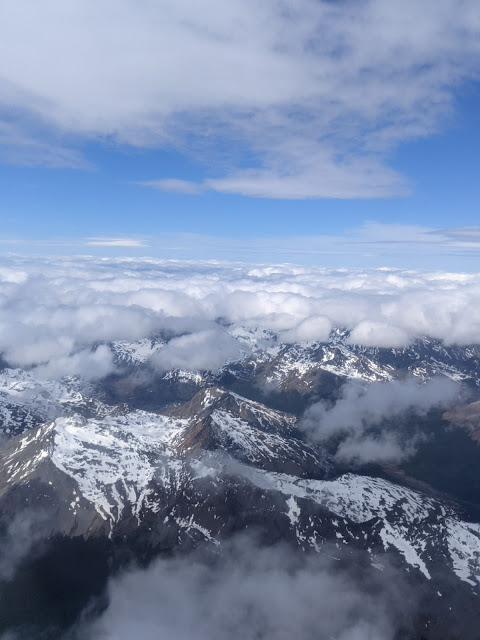
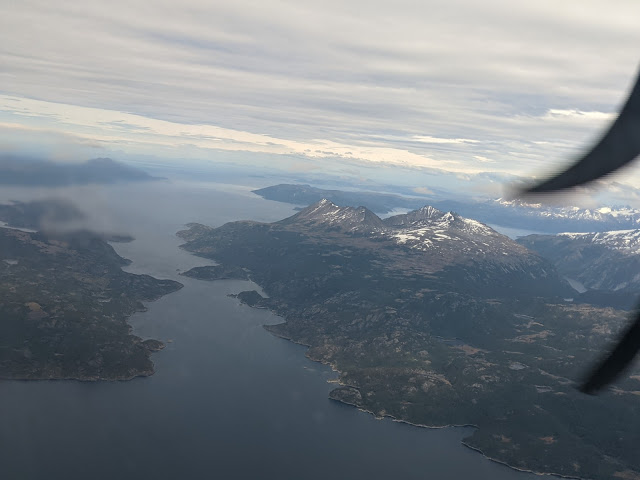
Flying over Tierra del Fuego on the way to Puerto Williams
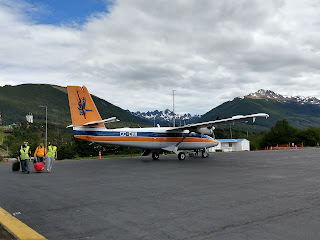
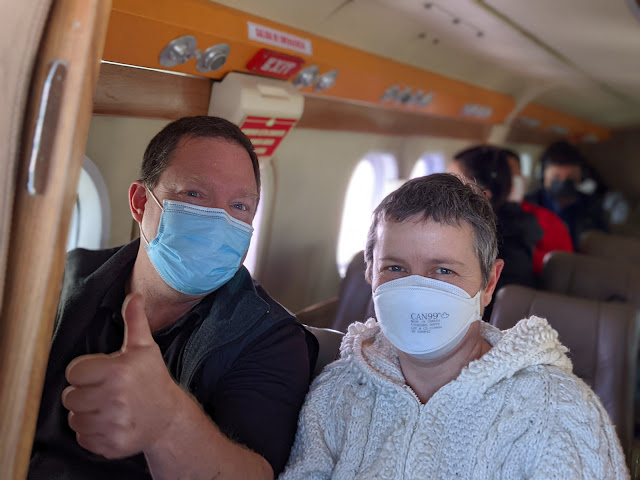
We stayed at the hotel on Monday as we couldn’t get a flight down to Puerto Williams that day.  At 4am Tuesday morning, we arrived at the airport and were astounded to find 3000 other people all trying to check into their flights.  It was nothing short of a gong show.  After an initial panic thinking we had to stand in a lineup that was literally 500 people long, we found the correct (and much shorter) line and waited to check in.  We made it to the front of the line in an hour and successfully checked in with our Mobility Pass and Sunday’s PCR test.  As it was the first test of the validity of the Mobility Pass, we were relieved that the check in was smooth.  We had a bumpy flight to Punta Arenas, then had to show our PCR results to get off the plane.  We checked in for our flight to Puerto Williams. We had to show the Mobility Pass and PCR results while standing in line to check in, at the check in desk, and to get on the plane – no one says the Chilean’s aren’t thorough!  The flight into Puerto Williams was awesome.  The plane is a 19-seater Twin Otter.  We sat right up at the front and enjoyed the views of Tierra del Fuego.  
The Otter Awaits!

The Beagle Channel - Looking West
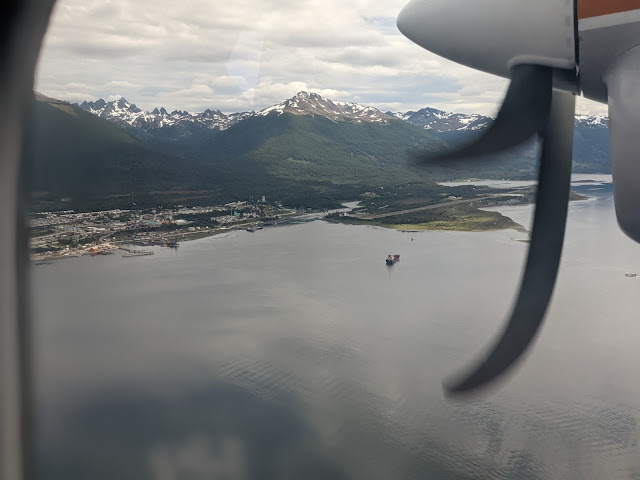
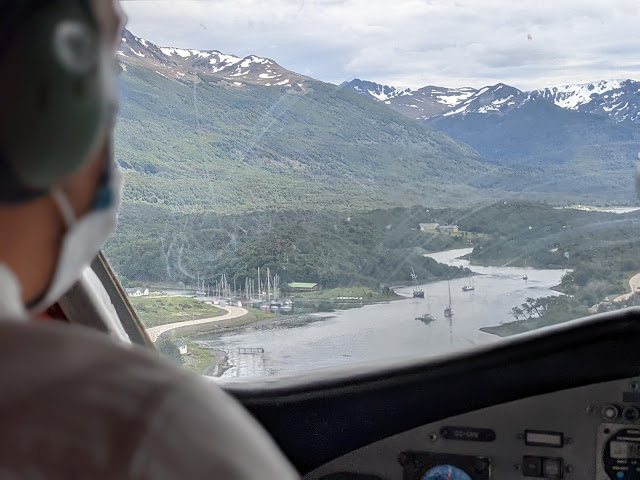
We had a great view of the Micalvi, where Sea Rover has spent the last 21 months, while landing.  We were hoping to catch a taxi at the airport, but I don’t think Puerto Williams is big enough to have one.  While we were standing outside trying to figure out whether someone could pick us up by boat (the airport is directly across the inlet where the marina is located), a couple of the airline employees came out and offered us a ride.  So, we met a couple of the locals. 


On Approach Into Puerto Williams


The Micalvi, Sea Rover's Home For the Last 2 Years, on the Left

We made it!  With some trepidation we got on board the boat…and were pleasantly surprised.  She actually looks pretty much how we left her.  More dirt, the dinghy was deflated, our gear tarp was pretty threadbare, but the canvas cockpit enclosure looked good and everything was right where we left it.  There was a bit of mold and things definitely smell musty, but so far so good.  We plugged in, got some water in the tanks, hooked up the propane and started to unpack.  So far we’ve sorted out the internet, bought a bit of food and sorted some of our clothes.  We haven’t looked at the batteries yet or tried to start the engine, so there are still a LOT of unknowns, and we really don't know what we are in for.  The next few days will determine what our future looks like...  Stay tuned for Part Two.


Monday, March 23, 2020

We've made it to Vancouver and are home!

Hmmm, it seems our last point was talking about just making it to Antarctica and all of the sudden we are at the other end of the world in Vancouver?  What happened?  Well as everyone knows, things are changing in the world and for once we aren't talking about climate change.

After a week long ordeal of pretty significant stress we are back in our home country.  We left Antarctica a day early but still arrived in Ushuaia unable to return to our boat in Chile.  Over the next few days we quickly learned the big disadvantage of being a foreign national in a country during a crisis. Our plans changed from going to the boat via ferry to via bus to via air to not at all.  Then they changed to staying in Ushuaia to needing to get out of Argentina to holy cow, will we actually get out or be forced to become a refugee in a make shift camp.

Something you never want to see in an airport when you are trying to get home
Everyone should perform heroic measures to get to their home country.
On a happy note, we are under Q flag for the next 14 days so we'll be able to put some pretty good posts together with good quality pictures that will clearly show how spectacular Falklands/South Georgia/Antarctica are.

Stay tuned

Thursday, March 12, 2020

We've made it to Antarctica!

We've been in Antarctica for the past couple of days but today we were finally able to actually stand on the continent. It's a pretty good feeling when you get to hold up the flag of the continent and have your picture taken surrounded by a bit of rock but mostly ice and snow. Yes, today we are now able to say 5 down and 2 to go.
Having said that, the zodiac excursions are what stole the show today. There certainly are not many days when I can say we had to stop taking pictures of the whales because we had to wipe the humpback snot off the camera lens. Both this morning's and this afternoon's excursions have been filled with so many whale encounters that some people on the boat are now calling them boring. I doubt we will ever get enough interactions with them to feel that way. Like some of the guides on board... We could spend years down here and never feel that we'd had too much.

Tuesday, March 10, 2020

Zodiac trip next to A-68

Today we did something that probably nobody has ever done.
In calm seas we approached A-68, the largest iceberg ever recorded. It calved off the mainland in 2017. Drifting about 150 NM from the Antarctic peninsula and at 100 NM long and 10 NM wide, it's really a slowly moving island. We arrived just before lunch and after a rushed 4 course meal we went up to the observation deck to have a look at the massive ice in front of us. Then we started seeing whales. Right, Fin and Humpbacks were all around the ship. The expedition leader figured this wasn't personal enough so he ordered the zodiacs launched and within minutes we had a very unexpected 2 hour dinghy cruise amongst the ice, whales and fur seals. At one point we had 3 humpbacks cruising slowly under the zodiac, at another we had a Right whale in between two humpback tails.
Its pretty hard to really describe how we felt, cruising beside an iceberg bigger than South Georgia with 2 KM of ocean below us and the unbelievable number of whales all around us. This is all before we have even reached Antarctica. We hope this trip's namesake wont be a let down but we really can't fathom how it can get better.

Saturday, March 7, 2020

Endurance is the name of the game

Today we marched across the plains above the abandoned whaling station Stromness, and then in the afternoon visited Grytviken where most of the 30 or so people who live on South Georgia call their home. Both Stromness and Grytviken are important names in the greatest story of survival in the history of polar exploration. Yes I am talking about Ernest Shackleton. I can't do the story justice here so if this post peaks your interest follow the interweb for the whole tale.

Shackleton in 1914 left England and set off on an expedition consisting of 27 men on board the sailing vessel Endurance. His hope was to become the first man to cross Antarctica. Due to an unusually thick ice pack and a freak wind shift they were trapped in the Weddell Sea not far from their planned Antarctica landing where they drifted frozen on the ice flow for many months until the ship was crushed by ice and finally sunk. The men eventually made their way to Elephant Island in 3 lifeboats, but given that there was no hope of rescue, Shackleton set off with 4 other men in a makeshift 23 ft sail boat with a mostly open deck. 16 days and 800 miles later they arrived on the desolate west shores of South Georgia, where due to the condition of their craft, Ernest was forced to cross the mountainous spine of the island on foot. 36 hours later despite the lack of any surveys on the island they managed to find their way to the small whaling station of Stromness and were then taken to Grytviken where Shackelton mounted 3 rescue attempts to save the men on Elephant island. The 4th (the first major Chilean Navy rescue mission) was successful and miraculously, every man survived the ordeal.

This morning we walked 2.5 km in a howling head wind (which swung against us on the way back) to the waterfall Shackelton was forced to rappel down to reach civilization after his ordeal slogging across the glaciers and peaks from the other side. It was a fitting start to a challenging day where many felt Shackelton's pain as they walked back from the edge of the cliff. Shackelton probably hadn't had food for 2 or 3 days and really hadn't had anything nourishing for about a year. We all hadn't been fed for at least an hour and were certainly feeling the effects. On the way back to the ship we were hit by a number of gusts and shortly after that a good blow clocked 60 knots on the ships wind meter.

We then moved down island to Grytviken where we braved many aggressive and viscous fur seals to wander amongst the creepy remains of the horrible history of this place. The scale of death here has been documented in uncensored fashion as you are taken through the process of carving up and distilling first seals and sea lions and then whales over a period of a couple of hundred years.

We have one more day on South Georgia and another 5am wake up call so we can squeeze in a few more wildlife viewing expeditions before we blast down to Antarctica. Many on board are now picking and choosing their adventures with care and keeping their energy as high as possible by consuming as many chocolate cookies as are available.

In the wake of Shackleton, Karina and I will endure these difficult days aboard the World Explorer.

Thursday, March 5, 2020

South Georgia is Amazing!!!

In the last 6 years, very few blog post titles have been given 3 marks of excitement. South Georgia is one of those places that can only be described with adjectives that conclude with at least 3 exclamation marks (more is better). For anyone that loves penguins this is a place that must be on your list. Getting here is not easy (ask Karina who spent most of yesterday's passage in bed) but once we arrived this morning it was full on spectacularness from 5 am till dark. We only were able to get to shore once (out of three tries) due to weather conditions but even if we dont make it ashore again we have enough pictures to keep us happy. In fact we filled up two memory cards with today's pictures alone.
On the shore visit we did managed to get to we saw fur seals, elephant seals and King penguins. A survey was last done about 5 to 10 years ago which numbered the penguin colony in the bay at 140 000. It's impossible to describe a colony of 140 000 birds that are 80 cm high packed into a bay less than two km wide. Add their goofy cartoonish motions, beautiful colouring and then the amazing scenery on top of that and all you can do is sit down and stare in awe... But then one of these goofy curious creatures walks up to you and you reach a sensory overload that can only be appreciated by those who have been here... Wow.
We have another early morning tomorrow. Here's hoping that the weather cooperates and our excellent guides get a chance to fully earn their well deserved pay.
For those keeping score. 4 down 4 to go...

Monday, March 2, 2020

3 Down 2 To Go

Well the first few days have been pretty successful on our quest to see the 8 possible Penguin species on land. Here on the Falklands we've seen the Rockhopper, Gentoo and Magellan Penguins. Funnily enough we've spent the past two years in Chile trying to see the Magellan Penguin on land. We've seen so many of them in the water where they moooo like cows but have always missed them on shore. Yesterday we hit the motherload and have now been able to check that box in spades.
We've got so many pictures but unfortunately we don't have great internet on board so you'll have to imagine the thousands of penguins we saw here in the Falklands. We'll post more when we get back to civilization.
The ship has kept us pretty busy with talks about wildlife, geology and even political commentary on the Falklands war. We've met people from all over the planet with the large majority of them taking a cruise for the first time. The only crisis we've had so far was when the ship was delayed bunkering today while we ashore exploring the town of Stanley. This two hour delay has become a scheduling nightmare for the kitchen staff which ensure a constant stream of food at 3 hour intervals... I'm not sure how people are going to manage having to eat lunch, afternoon tea and dinner all within 4 hours. Personally, I didn't find it a problem.